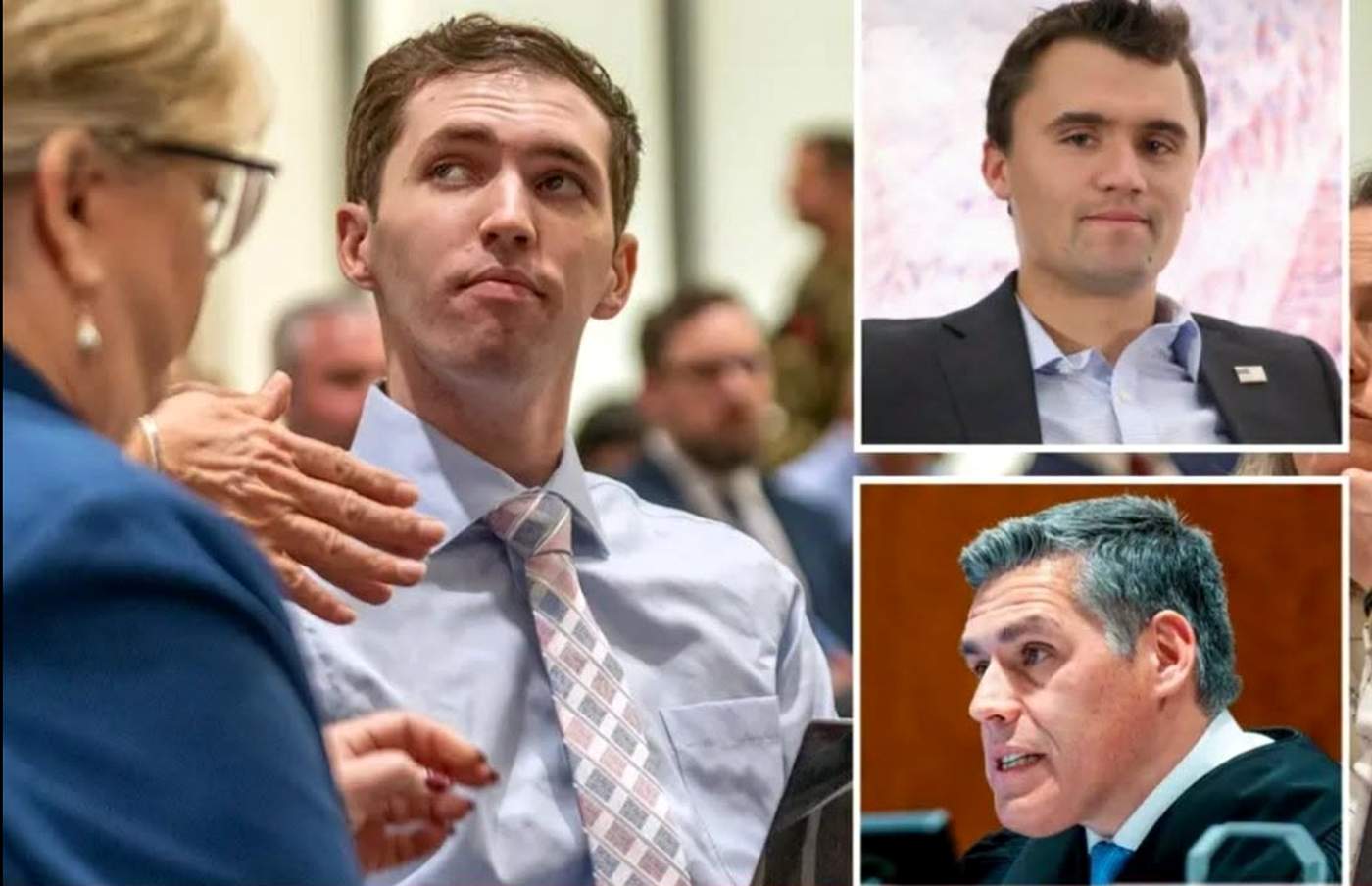
Attorneys representing Tyler Robinson, the 23-year-old charged with the assassination of conservative activist and Turning Point USA founder Charlie Kirk, are urging a Utah judge to eliminate the death penalty as a possible sentence.
In a lengthy new court filing, the defense claims prosecutors have failed to prove the key legal element that would make capital punishment available.
In a 41-page brief, defense attorneys Kathy Nester, Michael Burt, Richard Novak, and Staci Visser said the facts of the case and the law require the court to “strike the sole aggravating factor,” which is that the shooting created a high probability of death to someone apart from Kirk and that Robinson was aware of that high probability.
Without that factor, the potential death penalty would be removed as an option in the case.
The filing comes after a preliminary hearing held in July.
Judge Tony Graf Jr. gave both the prosecution and defense time to submit briefs before ruling on whether sufficient probable cause exists to advance the case to a full trial.
That decision is expected in the coming weeks.
Prosecutors allege that Robinson, 23, shot Kirk at Utah Valley University on Sept. 10, 2025, during a Turning Point USA event.
Kirk was speaking in front of a crowd of more than 2,000 people when he was struck in the neck and killed by a single bullet.
The brazen attack on a prominent conservative voice who had dedicated his life to engaging young Americans on college campuses shook the nation and underscored the growing threats faced by those who dare to challenge left-wing orthodoxy in public.
Defense lawyers contend that the state has not met its burden of proof on the aggravating circumstance required under Utah law for a capital case.
They argue that only one shot was fired, that it struck Kirk alone, and that no other individuals were endangered.
According to the brief, the trajectory of the bullet—fired from a rooftop perch—traveled above the assembled crowd rather than through it.
The suspected murder weapon, a .30-06 bolt-action Mauser rifle recovered with a spent casing and three unfired rounds, is presented by the defense as evidence of a single, deliberate target rather than reckless endangerment of bystanders.
The attorneys further point to communications introduced by prosecutors between Robinson and an associate, Lance Twiggs.
One message attributed to Robinson reads, “I had the opportunity to take out Charlie Kirk and I took it.”
The defense insists this language reveals an exclusive focus on Kirk and contains “no mention of any threat or intended harm to any other individual(s).”
They also challenge related charges and enhancements, including claims that the killing was motivated by Kirk’s political expression.
The filing disputes any inference that Robinson’s alleged personal relationships somehow prove the attack stemmed from disagreement with Kirk’s views on cultural issues.
“It is the State that argues that because Mr. Robinson and Mr. Twiggs are two men who love each other and/or, it speculates, because Mr. Twiggs (and not Mr. Robinson) was at least intermittently identifying as a female to his close friends, it is Mr. Kirk’s views on these topics which are the ‘hatred’ Mr. Robinson was referring to,” the defense wrote.
“These circumstances are not sufficient to establish, even by probable cause which if any political expression of Mr. Kirk motivated Mr. Robinson to select Mr. Kirk for an act of violence,” the defense added.
Prosecutors have until next week to respond.
The state’s theory maintains that the public setting—a packed university courtyard with thousands present—created precisely the kind of great risk to others that Utah’s aggravated murder statute contemplates.
Surveillance video allegedly shows the shooter approaching a sniper’s position overlooking the event, reinforcing the danger inherent in firing into a large gathering of civilians.
This latest defense maneuver is the second significant effort to shield Robinson from the ultimate penalty.
Earlier this year, the same legal team sought to strike the death penalty as a sanction after a prosecutor was held in contempt for certain public comments. Judge Graf rejected that request as disproportionate.
Now the focus has shifted to the sufficiency of the evidence itself at the probable-cause stage.
For conservatives who mourned Kirk’s murder as an assault on free speech and the conservative movement, the defense’s technical arguments risk appearing as an attempt to dilute accountability for a cold-blooded political assassination.
Kirk built Turning Point USA into a powerhouse that empowered students to stand against campus radicalism.
Utah County prosecutors have made clear their intention to pursue the death penalty if Robinson is convicted.