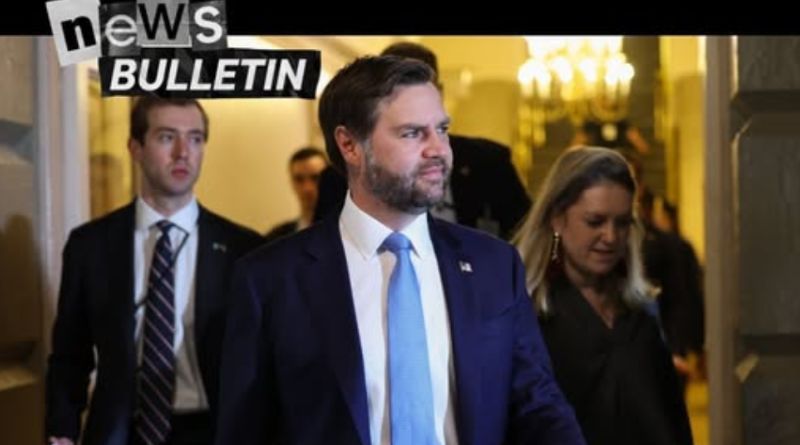
Vice President JD Vance reaffirmed his stance that the United States faces “no chance” of becoming drawn into a lengthy Middle East conflict should President Donald Trump approve further military steps against Iran.
While speaking aboard Air Force Two on Thursday, Vance emphasized that the administration has no plans for an extended “nation-building” effort in Iran involving large numbers of American troops on the ground.
“The notion that we would enter a Middle Eastern war lasting years without a clear endpoint—there is no chance that will happen,” Vance told The Washington Post.
The United States has consistently held that uranium enrichment activities within Iran could lead to nuclear weapons development and has made clear that Tehran must not be permitted to acquire such a weapon.
Following his appearance on “Jesse Watters Primetime” on Monday, Vance reinforced the administration’s position on social media.
President Trump will not get the United States into a years-long conflict with no clear objective.
Iran can never be allowed to obtain a nuclear weapon. That is the goal of this operation and President Trump will see it through to completion. pic.twitter.com/Spi2Mcke6F
— JD Vance (@JDVance) March 3, 2026
“President Trump will not involve the United States in a multi-year conflict lacking defined goals,” Vance posted. “Iran can never be allowed to obtain a nuclear weapon. That is the objective of this operation, and President Trump will carry it through to the end.”
The ongoing U.S.-Iran conflict reached its third full day on Tuesday, marked by increasing American losses, broader Israeli military operations, and United Nations confirmation that at least one Iranian nuclear site has been damaged since the beginning of joint U.S.-Israeli actions.
The U.S. military reported on Monday that the death toll among American service members in the conflict has climbed to six. Two individuals previously listed as missing were later confirmed deceased after recovery of their remains.
President Donald Trump characterized the campaign as the “last best chance” to eliminate the dangers posed by Iran’s ballistic missile capabilities and nuclear-related infrastructure.
In statements to the New York Post, Trump indicated the operation might continue for “four to five weeks,” while noting it has “the capability to go far longer than that.” He did not exclude the possibility of sending U.S. ground forces if required.
The fighting has expanded to additional locations. Israel stated it is carrying out “simultaneous strikes in Tehran and Beirut,” hitting Iranian military targets along with Hezbollah sites in Lebanon. Israeli troops have ramped up ground activities in southern Lebanon alongside ongoing airstrikes within Iran.
For the first time since the coordinated U.S.-Israeli offensive began, the United Nations verified damage to an Iranian nuclear facility. Specific information on the scale of the damage remains undisclosed publicly.
Iran has persisted with counterstrikes using missiles and drones aimed at U.S. interests and regional partners. The Saudi Ministry of Defense reported Monday that two drones hit areas near the U.S. Embassy compound in Riyadh, resulting in limited property damage but no injuries.
Amid the deteriorating security environment, the United States has shuttered its embassies in Saudi Arabia and Kuwait while advising American citizens to leave more than a dozen nations throughout the Middle East.
The State Department has released revised travel advisories, pointing to continued missile threats and the risk of additional escalation.
The conflict has produced heavy losses on multiple sides.
Iran’s state-linked Red Crescent organization reported 555 deaths within Iran.
In Israel, local officials indicated that at least 11 individuals have died from Iranian missile attacks.
Adding to the challenges, Kuwait downed three U.S. F-15 fighter jets in an episode the Pentagon classified as a “friendly fire incident.” All pilots ejected safely. American authorities stated that an inquiry is examining the circumstances of the misidentification.
President Trump expressed doubts about pursuing fresh diplomatic efforts, despite indications that Iran has pursued back-channel discussions. “They want to talk,” Trump remarked, though he suggested the window for meaningful negotiations may have closed.